
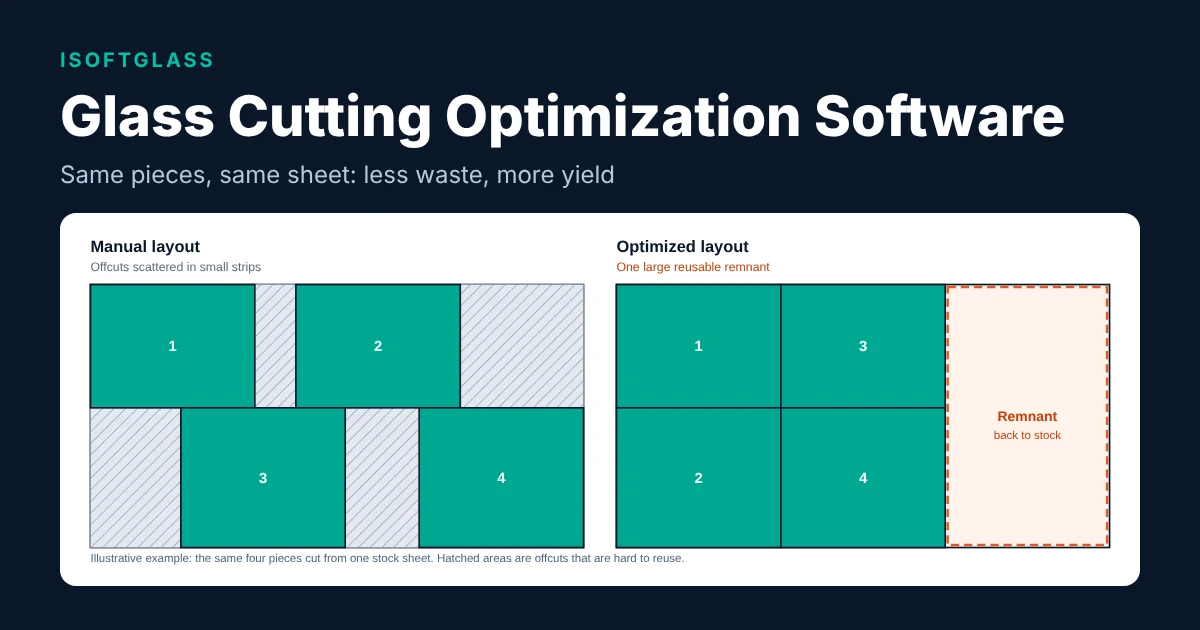
Every sheet of glass you cut has two outputs: finished products and money left on the cutting table. Glass cutting optimization software exists to shrink the second one.
The question is not whether your workshop produces waste. The question is how much that waste is costing you every year, and how much of it can be prevented.
By the iSoftGlass team · Updated October 2026 · 7 min read
What is glass cutting optimization software?
Glass cutting optimization software (also spelled optimisation) plans how every piece in your orders is cut from stock sheets so that as little glass as possible is left as offcuts. It raises yield and lowers raw-material cost, and raw glass is a major material cost for any glass processor. The most useful tools do not work alone: they take the cutting list from the order and pass the result to production, which is what glass manufacturing software does in one system.
Quick answers
- Yield formula: area used in finished pieces ÷ area of sheets cut × 100. Waste is 100 − yield.
- What one point is worth: at 200 sheets a week and €72 a sheet (illustrative), one percentage point of yield is about €7,500 a year.
- Biggest levers: optimized layouts, reusable remnants, cutting lists generated from the order, batching by glass type, fewer breakages.
- Who needs it: glass processors that cut sheets. Installers who buy cut glass usually need only the quoting side.
- In iSoftGlass: glass cutting optimization software is included in the Calculators + Operations + Processing plan, €150 per month in October 2026.
What is one point of better yield worth to your factory?
Yield (%) = area of glass used in finished pieces ÷ area of sheets cut × 100
Waste (%) = 100 − yield
Illustrative example (made-up numbers): a sheet costs €72 and you cut 200 sheets a week. Annual sheet spend is €72 × 200 × 52 = €748,800. One percentage point of yield is worth about €7,500 a year. Replace the numbers with your own prices and volumes.
For scale, one software vendor estimated that a processor cutting 200 sheets a week could lose up to £86,400 a year to wastage, using its own price assumptions (Glass Times). Treat it as a vendor estimate, not a benchmark.
7 ways glass cutting optimization software and good practice cut waste
%22%3E%3Crect width=%2210%22 height=%2210%22 fill=%22%23E3E9F0%22/%3E%3Cline x1=%220%22 y1=%220%22 x2=%220%22 y2=%2210%22 stroke=%22%239AA9BB%22 stroke-width=%222%22/%3E%3C/pattern%3E%3C/defs%3E%3Crect width=%221280%22 height=%22420%22 fill=%22%23FFFFFF%22/%3E%3Ctext x=%2220%22 y=%2230%22 font-family=%22Arial,Helvetica,sans-serif%22 font-size=%2220%22 font-weight=%22700%22 fill=%22%230A1628%22%3EManual layout%3C/text%3E%3Ctext x=%2220%22 y=%2254%22 font-family=%22Arial,Helvetica,sans-serif%22 font-size=%2215%22 fill=%22%235B6B7E%22%3EOffcuts scattered in small strips%3C/text%3E%3Crect x=%2220%22 y=%2270%22 width=%22600%22 height=%22320%22 fill=%22%23EEF3F8%22 stroke=%22%230A1628%22 stroke-width=%222%22/%3E%3Crect x=%22220%22 y=%2270%22 width=%2250%22 height=%22150%22 fill=%22url(%23hatch)%22 stroke=%22%238A9BB0%22 stroke-width=%221%22/%3E%3Crect x=%22470%22 y=%2270%22 width=%22150%22 height=%22150%22 fill=%22url(%23hatch)%22 stroke=%22%238A9BB0%22 stroke-width=%221%22/%3E%3Crect x=%2220%22 y=%22220%22 width=%22110%22 height=%22170%22 fill=%22url(%23hatch)%22 stroke=%22%238A9BB0%22 stroke-width=%221%22/%3E%3Crect x=%22330%22 y=%22220%22 width=%2290%22 height=%22170%22 fill=%22url(%23hatch)%22 stroke=%22%238A9BB0%22 stroke-width=%221%22/%3E%3Crect x=%2220%22 y=%2270%22 width=%22200%22 height=%22150%22 fill=%22%2300A892%22 stroke=%22%230A1628%22 stroke-width=%222%22/%3E%3Ctext x=%22120.0%22 y=%22151.0%22 text-anchor=%22middle%22 font-family=%22Arial,Helvetica,sans-serif%22 font-size=%2218%22 font-weight=%22700%22 fill=%22%23FFFFFF%22%3E1%3C/text%3E%3Crect x=%22270%22 y=%2270%22 width=%22200%22 height=%22150%22 fill=%22%2300A892%22 stroke=%22%230A1628%22 stroke-width=%222%22/%3E%3Ctext x=%22370.0%22 y=%22151.0%22 text-anchor=%22middle%22 font-family=%22Arial,Helvetica,sans-serif%22 font-size=%2218%22 font-weight=%22700%22 fill=%22%23FFFFFF%22%3E2%3C/text%3E%3Crect x=%22130%22 y=%22220%22 width=%22200%22 height=%22170%22 fill=%22%2300A892%22 stroke=%22%230A1628%22 stroke-width=%222%22/%3E%3Ctext x=%22230.0%22 y=%22311.0%22 text-anchor=%22middle%22 font-family=%22Arial,Helvetica,sans-serif%22 font-size=%2218%22 font-weight=%22700%22 fill=%22%23FFFFFF%22%3E3%3C/text%3E%3Crect x=%22420%22 y=%22220%22 width=%22200%22 height=%22170%22 fill=%22%2300A892%22 stroke=%22%230A1628%22 stroke-width=%222%22/%3E%3Ctext x=%22520.0%22 y=%22311.0%22 text-anchor=%22middle%22 font-family=%22Arial,Helvetica,sans-serif%22 font-size=%2218%22 font-weight=%22700%22 fill=%22%23FFFFFF%22%3E4%3C/text%3E%3Ctext x=%22660%22 y=%2230%22 font-family=%22Arial,Helvetica,sans-serif%22 font-size=%2220%22 font-weight=%22700%22 fill=%22%230A1628%22%3EOptimized layout%3C/text%3E%3Ctext x=%22660%22 y=%2254%22 font-family=%22Arial,Helvetica,sans-serif%22 font-size=%2215%22 fill=%22%23C2410C%22%3EOne large reusable remnant%3C/text%3E%3Crect x=%22660%22 y=%2270%22 width=%22600%22 height=%22320%22 fill=%22%23EEF3F8%22 stroke=%22%230A1628%22 stroke-width=%222%22/%3E%3Crect x=%221063%22 y=%2273%22 width=%22194%22 height=%22314%22 fill=%22%23FFF3EC%22 stroke=%22%23E4571F%22 stroke-width=%223%22 stroke-dasharray=%2210 6%22/%3E%3Crect x=%22660%22 y=%2270%22 width=%22200%22 height=%22150%22 fill=%22%2300A892%22 stroke=%22%230A1628%22 stroke-width=%222%22/%3E%3Ctext x=%22760.0%22 y=%22151.0%22 text-anchor=%22middle%22 font-family=%22Arial,Helvetica,sans-serif%22 font-size=%2218%22 font-weight=%22700%22 fill=%22%23FFFFFF%22%3E1%3C/text%3E%3Crect x=%22660%22 y=%22220%22 width=%22200%22 height=%22170%22 fill=%22%2300A892%22 stroke=%22%230A1628%22 stroke-width=%222%22/%3E%3Ctext x=%22760.0%22 y=%22311.0%22 text-anchor=%22middle%22 font-family=%22Arial,Helvetica,sans-serif%22 font-size=%2218%22 font-weight=%22700%22 fill=%22%23FFFFFF%22%3E2%3C/text%3E%3Crect x=%22860%22 y=%2270%22 width=%22200%22 height=%22150%22 fill=%22%2300A892%22 stroke=%22%230A1628%22 stroke-width=%222%22/%3E%3Ctext x=%22960.0%22 y=%22151.0%22 text-anchor=%22middle%22 font-family=%22Arial,Helvetica,sans-serif%22 font-size=%2218%22 font-weight=%22700%22 fill=%22%23FFFFFF%22%3E3%3C/text%3E%3Crect x=%22860%22 y=%22220%22 width=%22200%22 height=%22170%22 fill=%22%2300A892%22 stroke=%22%230A1628%22 stroke-width=%222%22/%3E%3Ctext x=%22960.0%22 y=%22311.0%22 text-anchor=%22middle%22 font-family=%22Arial,Helvetica,sans-serif%22 font-size=%2218%22 font-weight=%22700%22 fill=%22%23FFFFFF%22%3E4%3C/text%3E%3Ctext x=%22640%22 y=%220%22%3E%3C/text%3E%3Ctext x=%221160%22 y=%22236%22 text-anchor=%22middle%22 font-family=%22Arial,Helvetica,sans-serif%22 font-size=%2217%22 font-weight=%22700%22 fill=%22%23C2410C%22%3ERemnant%3C/text%3E%3Ctext x=%221160%22 y=%22258%22 text-anchor=%22middle%22 font-family=%22Arial,Helvetica,sans-serif%22 font-size=%2214%22 fill=%22%23C2410C%22%3Eback to stock%3C/text%3E%3Ctext x=%2220%22 y=%22408%22 font-family=%22Arial,Helvetica,sans-serif%22 font-size=%2214%22 fill=%22%234F6481%22%3EIllustrative example: the same four pieces cut from one stock sheet. Hatched areas are offcuts that are hard to reuse.%3C/text%3E%3C/svg%3E)
1. Let glass cutting optimization software plan every sheet
An optimizer compares many arrangements of the same cutting list and picks the one that leaves the least waste. Manual layouts depend on operator experience and time pressure. This is the biggest single gain for most workshops.
2. Keep offcuts as reusable remnants
A large offcut is stock, not scrap. Record its glass type, thickness and size so the next layout can use it. Unrecorded remnants end up thrown away.
A simple example: Order A leaves a 1,200 × 600 mm remnant. Two days later, Order B needs a 1,100 × 500 mm piece of the same glass type and thickness. If the remnant was recorded in stock, it can be reused. If nobody knows it exists, a new sheet may be opened while usable glass remains on the rack.
A large offcut is not waste if your system knows it exists.
3. Generate cutting lists from the order, not by retyping
Every manual re-entry of dimensions risks a wrong millimeter and a piece cut twice. When quote, order and cutting list share one data source, that error source disappears. This is the main reason to run quoting and production in the same system, in the same glass manufacturing software. How quotes are priced is covered in the guide to glass calculation software.
4. Batch orders by glass type and thickness
The more pieces of one glass type and thickness are planned together, the more arrangements the optimizer can try. Cutting one order at a time usually leaves more waste.
5. Reduce breakage during scoring and handling
A perfect layout fails if the piece breaks. Equipment makers advise matching the cutting wheel to the job, replacing worn wheels, maintaining the machine and moving glass with controlled acceleration (Billco).
6. Separate and move glass promptly after scoring
The same guidance recommends separating glass soon after scoring and keeping a first-in, first-out flow so scoring and breakout timing stay consistent.
7. Track yield every week
Report yield per sheet, per glass type and per month. A drop shows which product, operator or order mix caused it, instead of surfacing in the accounts.
Want to see your own cutting list optimized?
Bring a real order to a free iSoftGlass demo.
Where glass cutting optimization software fits in the production workflow
An optimizer on its own only rearranges pieces on a sheet. The money is saved when its result connects to the rest of the workflow, from the order to the euro figure at the end.
Every break in this chain means retyping, guessing or a sheet opened unnecessarily. That is why standalone optimizers often help less than the same function inside one system, which is what glass ERP software is built for.
What to check in glass cutting optimization software before you buy
Use these six questions for any glass cutting optimization software, whether it is built into a larger system or sold as a standalone tool.
| Question | Why it matters |
|---|---|
| Does it handle your glass types and thicknesses? | Layouts are planned per material, so the catalogue must match your stock. |
| Can it record and reuse remnants? | Reusable offcuts turn waste into stock. |
| Does the cutting list come straight from the order? | No retyping means fewer dimension errors and re-cuts. |
| Does it work with your cutting table or CNC? | A good layout only helps if the machine can run it. |
| Does it report yield and waste? | You need the number to know whether it works. |
| How long until you use it? | Long setups delay the savings. |
Glass cutting optimization software in iSoftGlass: what it does and what it costs
iSoftGlass is cloud-based glass manufacturing software built only for glass processors and installers. For processors, it adds optimization of the cutting plan to the same system that holds quotes, orders and production. Facts below come from the iSoftGlass website in October 2026.
What iSoftGlass states
| Topic | What iSoftGlass states |
|---|---|
| Cutting optimization | Optimizes the cutting plan to reduce material waste. Part of the Processing module. |
| Plan and price | Calculators + Operations + Processing: €150 per month. Also includes processing sheets and a CAD editor. |
| Production sheet | Generated automatically from a confirmed order, with materials reserved from stock. |
| Remnants and stock | Inventory control with minimum-level alerts is listed. Reusable remnant tracking is not described on the website, so ask about it in the demo. |
| Piece tracking | Each glass piece is tracked from cutting to delivery, visible to office, production and management. |
| Machines | Lists machine and CNC connectivity for automatic data transfer. Verify your model in the demo. |
| Languages | Interface in 11 languages. |
| Terms | No setup fees, cancel anytime. Free updates, support, cloud access and backups in every plan. |
| Not for | Installers who do not cut glass. The €60 per month Calculators plan covers their quoting and 3D configuration. |
Break-even check
Break-even check using the illustrative numbers above: the plan costs 12 × €150 = €1,800 a year, while one yield point is worth about €7,500. In that example, a gain of about a quarter of a point covers the cost. Use your own volumes. See the current plans on the iSoftGlass pricing page.
The right question is therefore not simply “How much does the software cost?” but “How much waste does it need to prevent before it pays for itself?”
Glass cutting optimization software: frequently asked questions
What it is and how yield works
What is glass cutting optimization software?
Glass cutting optimization software calculates how pieces are cut from stock sheets so the least possible glass is left as offcuts. It replaces layouts made by hand and raises yield, the share of glass that ends up in finished products.
Does glass manufacturing software include cutting optimization?
Many systems do, but not all, and some sell it as a separate add-on. In iSoftGlass, cutting optimization is part of the Calculators + Operations + Processing plan, listed at €150 per month in October 2026.
How do you calculate glass yield?
Divide the area of glass used in finished pieces by the area of the sheets cut, then multiply by 100. Waste is 100 minus yield.
Cost and who needs it
How much does glass cutting optimization software cost?
Prices vary by vendor. iSoftGlass lists three monthly plans in euros in October 2026: Calculators at €60, Calculators + Operations at €100, and Calculators + Operations + Processing at €150, with no setup fees and cancellation at any time. Cutting optimization is in the €150 plan.
Do installers need glass cutting optimization software?
Usually not. Installers who buy cut glass do not cut sheets themselves. For them, iSoftGlass offers the Calculators plan (€60 per month in October 2026) for quoting and 3D configuration.
Remnants, nesting and machines
Can leftover glass be reused?
Yes. A large offcut can be kept as stock if its type, thickness and size are recorded, and used in a later layout instead of being scrapped.
Is cutting optimization the same as nesting?
Nesting is one technique inside optimization: arranging pieces on a sheet so they fit with minimal gaps. Optimization also covers batching orders by glass type and thickness, and handling remnants.
Does iSoftGlass connect to cutting machines and CNC?
iSoftGlass lists machine and CNC connectivity for automatic data transfer on its processors page. Confirm support for your specific cutting table during the demo.
See glass cutting optimization software work on your own cutting list
Schedule a free demo, bring a real order and see it quoted, optimized and sent to production in one system. No setup fees. Cancel anytime.
Sources: iSoftGlass – Pricing · iSoftGlass – Processors · Glass Times – wastage estimate · Billco – Tips for reducing scrap. Prices checked October 2026.